 Fine-tune open-weight models · You own the result
Your own AI model, trained on your data
Generic models guess; they've never seen your tickets, contracts, codebase, or determinations. Upload your documents, fine-tune a top open-weight model, and get a private endpoint that answers like your team : hosted or inside your own walls.
Some features call third-party APIs : Privacy 3a says exactly what goes where, and in-house deployment keeps everything on your side.
No spam, and no email until we have something to tell you.
Private + Owned
Your data, weights & endpoint
1-Line Swap
Drop into the OpenAI SDK
Model-Level MCP
Connect your tools in a click
Your data. Your model. Your jurisdiction.
A hosted API can log, cache, train on, or staff-review everything you send it. Here, the model is trained on your data and answers only you.
Private end to end
Encrypted uploads that never train a shared model, delete-after-training, and weights you can export and run anywhere.
Drop-in for any dev team
Every model ships an OpenAI-compatible endpoint. Point base_url at it and ship, LangChain, Cursor, OpenCode, anything.
Model-level MCP
Connect knowledge bases, ticketing, or internal APIs per model. Credentials encrypted once, scoped to that model, zero infra.
The entire integration
from openai import OpenAI

client = OpenAI(
    base_url="https://app.infoplatform.ai/api/v1",
    api_key="mf_sk_…",
)
client.chat.completions.create(
    model="your-model-id",
    messages=[{"role": "user", "content": "Hi"}],
)
Trained on your work, not the whole internet
Every job below runs the same play: upload examples of the work you want done, fine-tune, deploy behind a private endpoint.
CUI Identification under CMMC
Problem
CUI arrives unmarked or mis-marked, and DFARS bars non-FedRAMP cloud services from touching it.
Fix
A classifier pointed at the NARA CUI Registry, deployed in-house by contract so data never leaves your boundary.
In practice
Drop in a contract, get a proposed CUI category with the registry text quoted beside it.
Post-Quantum Migration Copilot
Problem
PQC deadlines are here, but your cryptographic inventory is too sensitive for any SaaS.
Fix
Fine-tune on your codebase to build a CBOM, risk-rank quantum-vulnerable crypto, and draft migration PRs inside your walls.
In practice
Point it at your repos, not a line of code leaves your network.
Per-Client Models for Forward Deployed Engineers
Problem
Client data can't enter multi-tenant SaaS, and generic models miss because they never saw that client's corpus.
Fix
One tenant per engagement, each with its own model and endpoint. Same day, hosted single-tenant or inside the client's walls.
In practice
The client can revoke your access anytime, everything you built for them stays intact.
One Platform, Every Model
Open-weight models are now genuinely competitive on quality. Fine-tune the best of them and own them outright, with no shared-model lock-in.
Kimi K2.6
OpenMoonshot · Open
Elite tool use and long-horizon agent workflows.
Open · you own the weights
DeepSeek V3.1
OpenDeepSeek · MIT
Long-context reasoning & coding specialist.
Open · you own the weights
Qwen 3.5 397B
OpenAlibaba · Apache 2.0
Large-scale open MoE. Multilingual & agentic.
Open · you own the weights
Nemotron 3 Ultra 550B
OpenNVIDIA · Open
Top-tier reasoning at the largest open scale.
Open · you own the weights
GPT-OSS 120B
OpenOpenAI · Apache 2.0
Open-weight reasoning model, yours to run.
Open · you own the weights
Inkling
OpenThinking Machines · Apache 2.0
Open-weight 975B multimodal MoE: text, image & audio. Fine-tune via Tinker.
Open · you own the weights
Every model fine-tunes as the exact weights you pick, no substitute base, from 3B models up to 1T-parameter open MoEs. New open-weight releases are added within days.
From Data to Deployed in 6 Simple Steps
No ML expertise required. Our guided workflow handles the complexity so you can focus on results.
Upload Data
Spreadsheets, docs, or code
Pick a Model
Open-weight, yours to keep
Describe Goal
Tell us what you need
Viability Check
We check if it'll work
Train & Test
Chat, rate, get better
Go Live
OpenCode, Cursor, your app
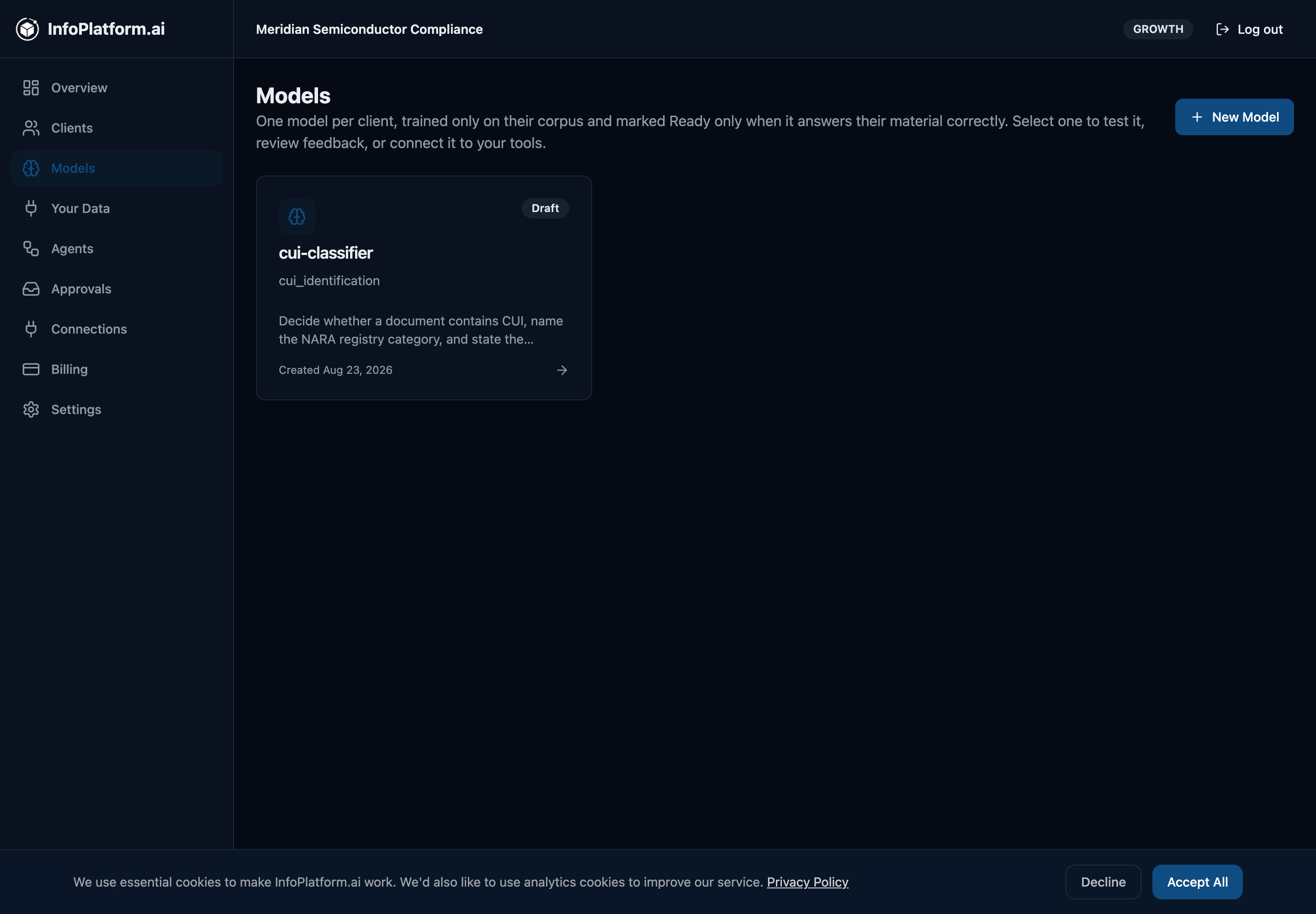
Every tab in the app, doing real work
Real screenshots from the live product, not designed mockups.
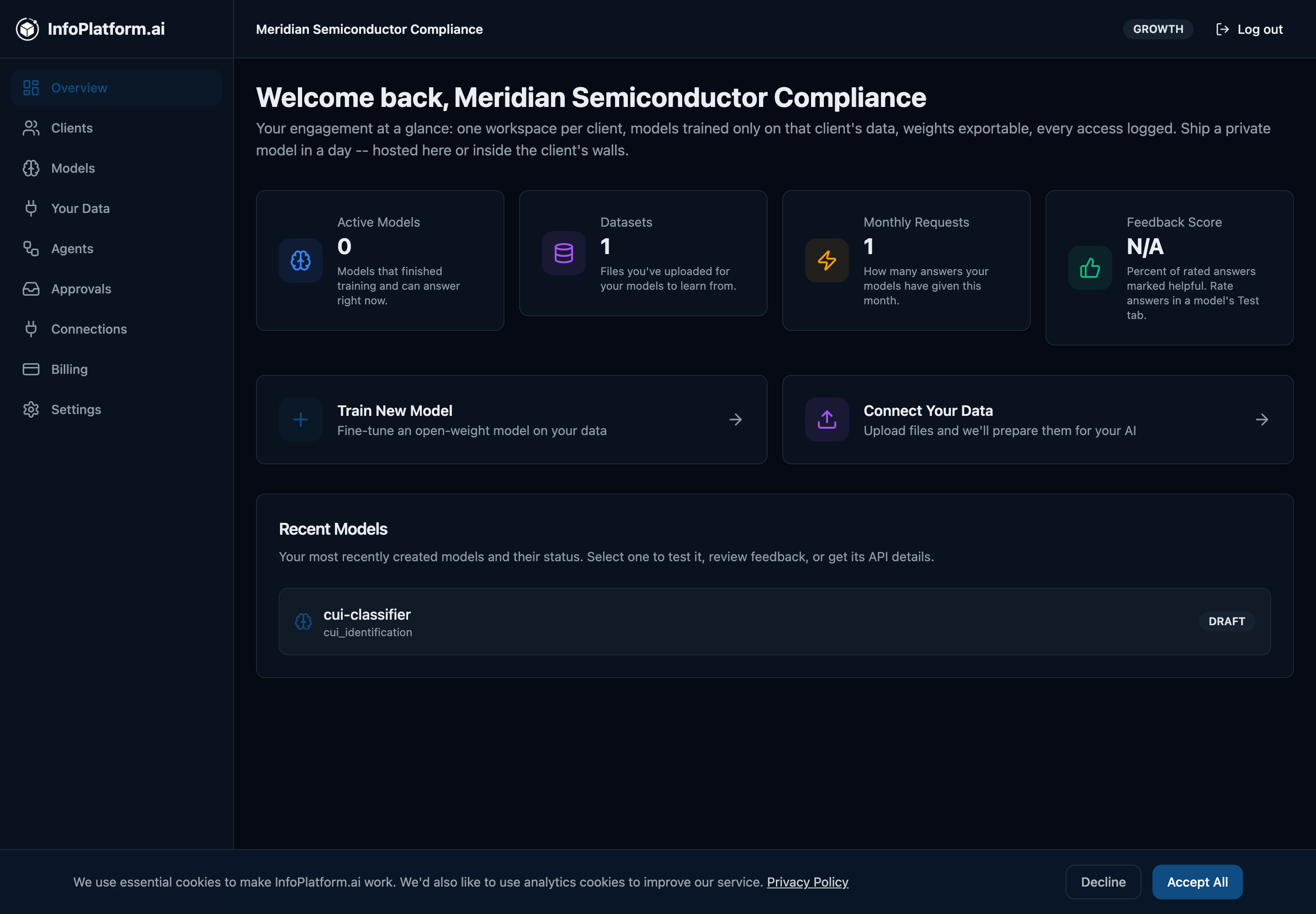
Overview
Everything at a glance
Active models, datasets, requests, and feedback score in one view.
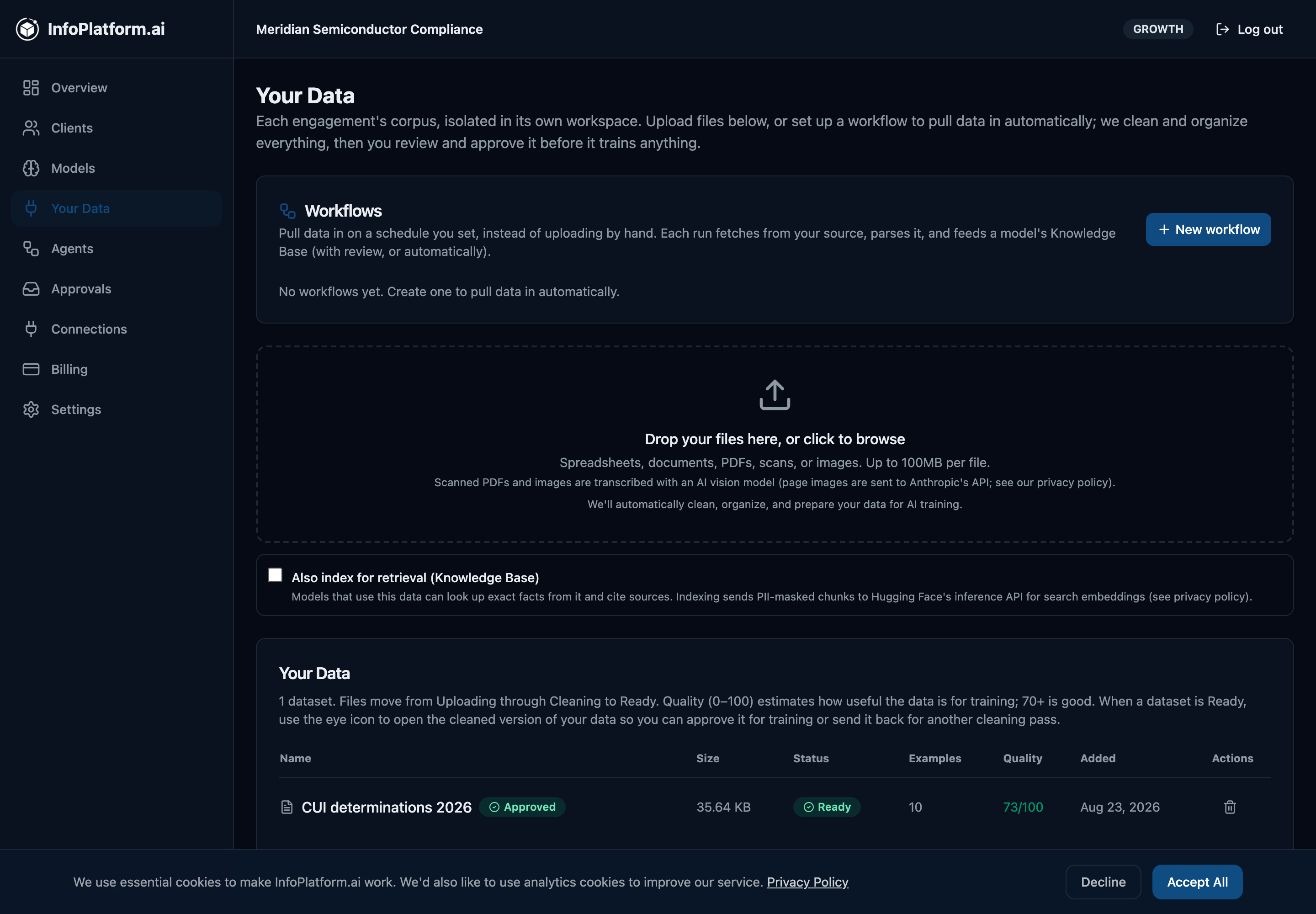
Your Data
Upload once, ready to train
Drag-and-drop files, each scored for quality before you train on it.
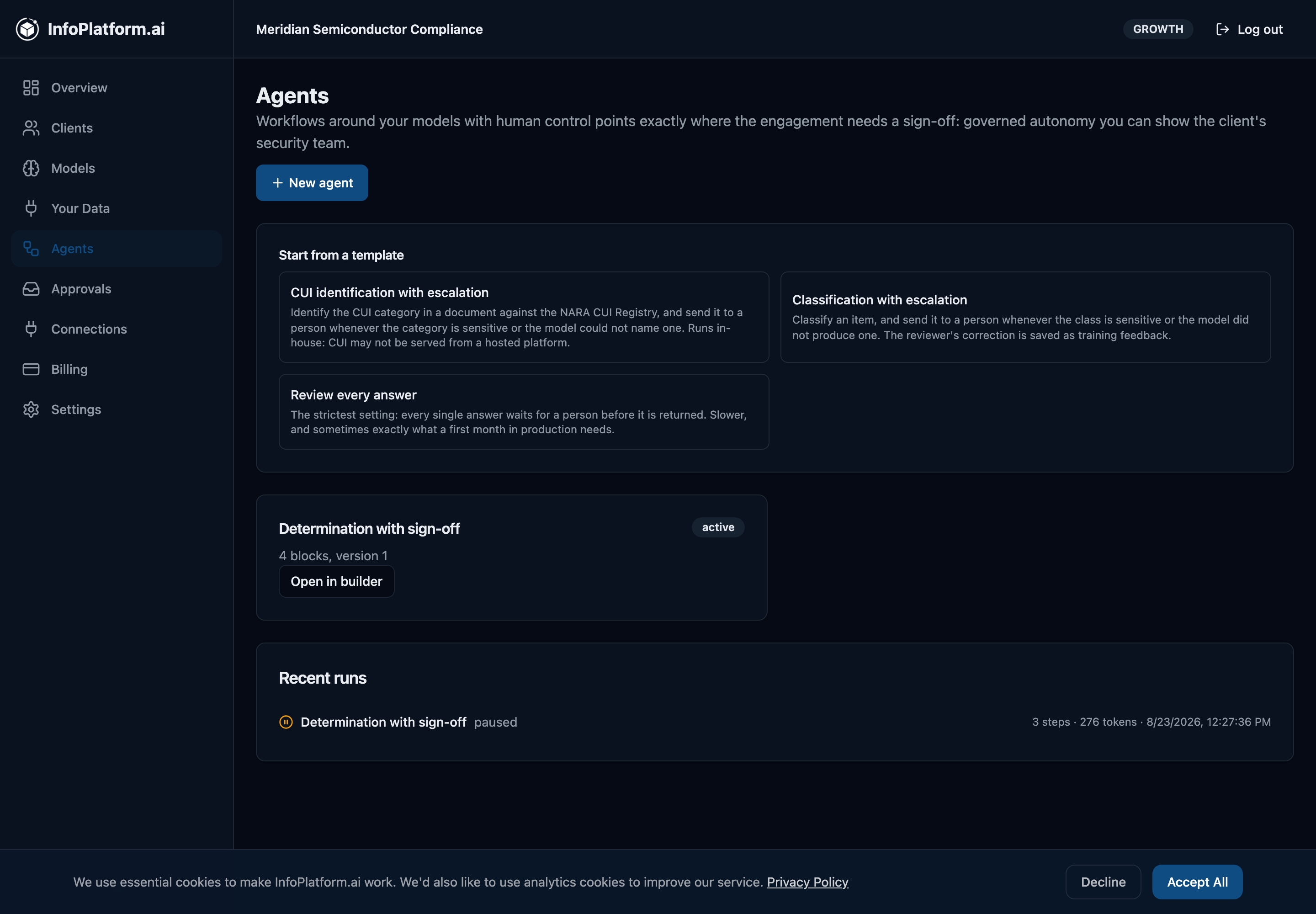
Agents
Workflows with human control points
Chain your models and drop a review step wherever you want one.
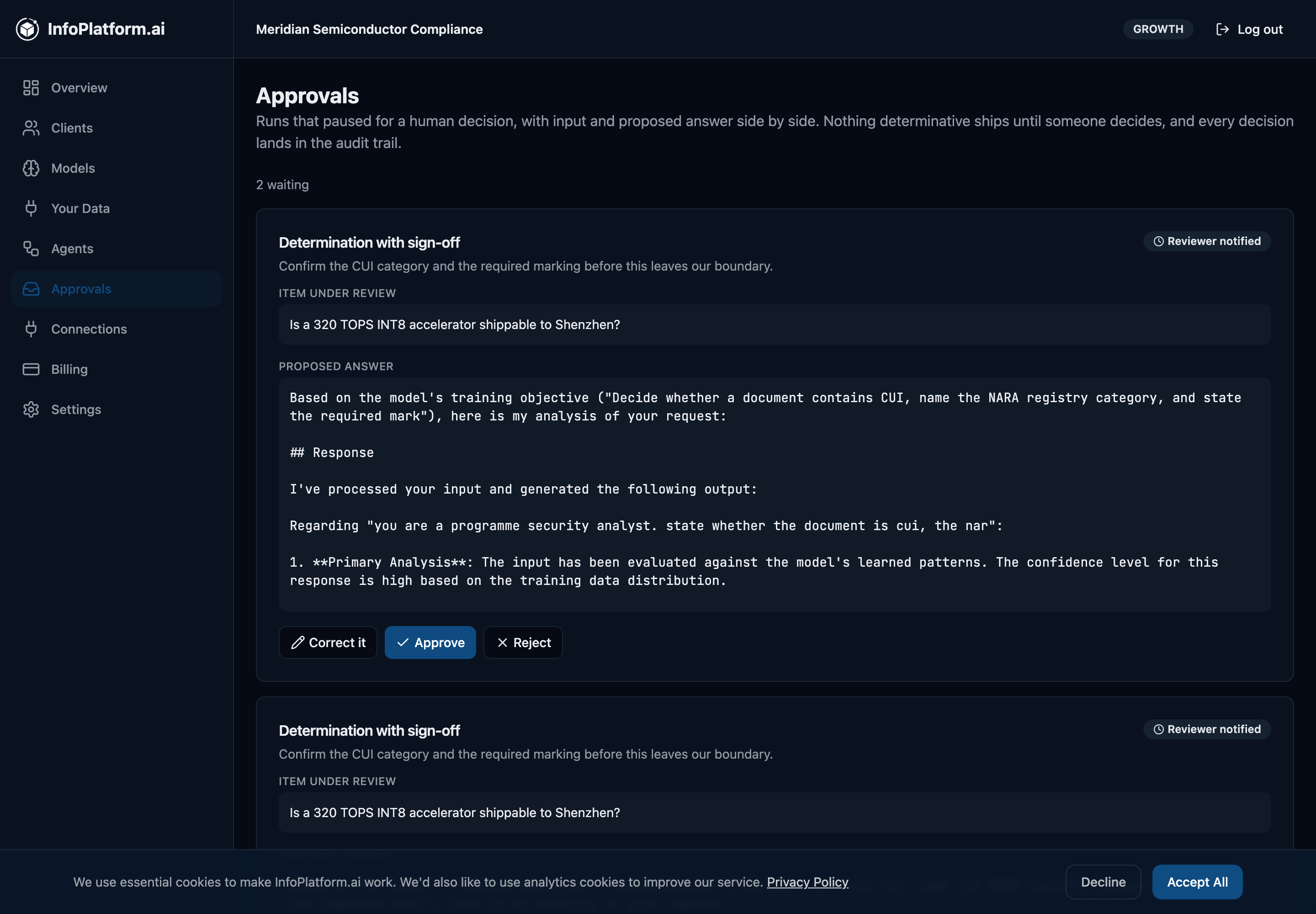
Approvals
Nothing ships without a person
Runs pause here until someone approves, corrects, or rejects, fully audited.
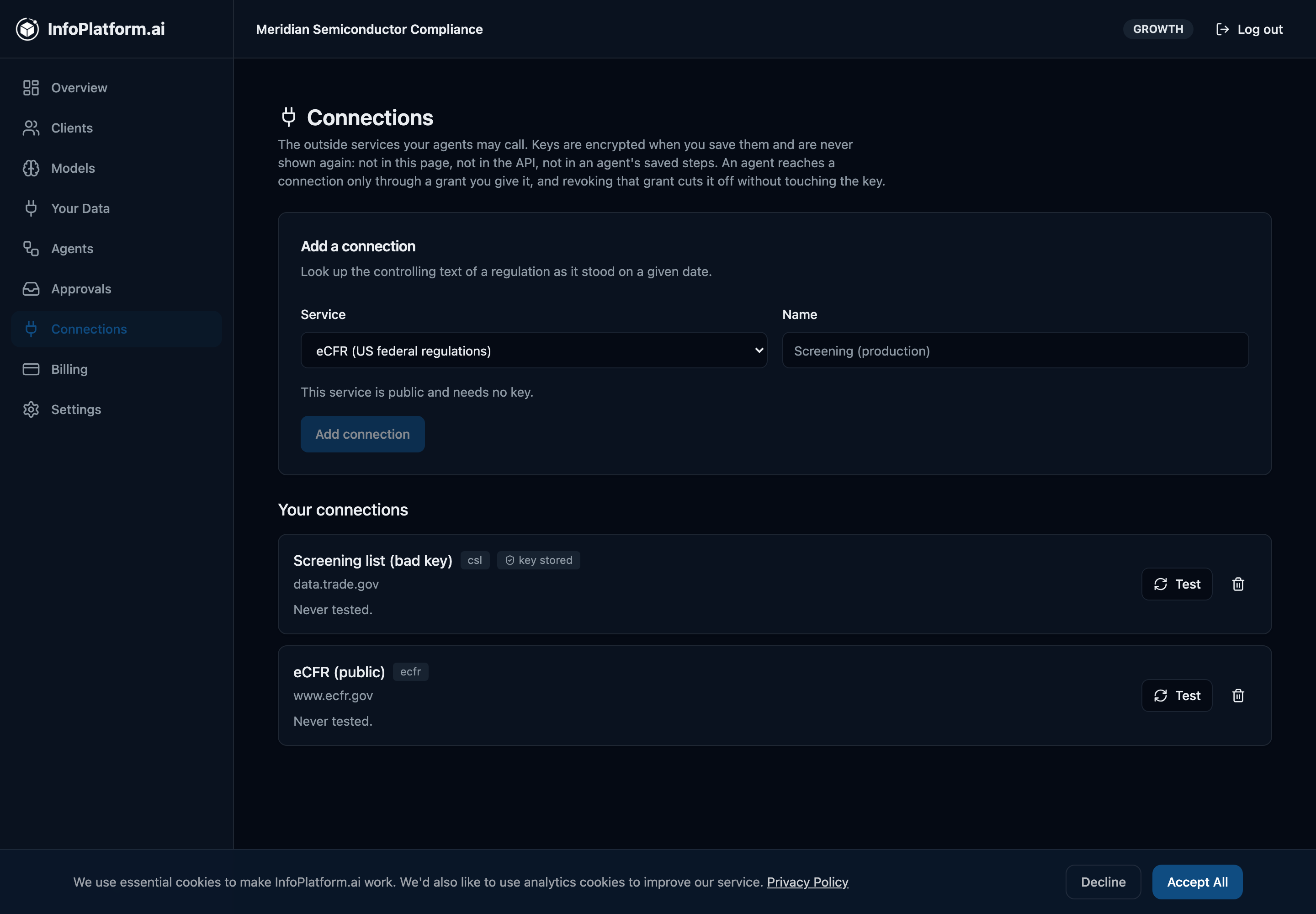
Connections
Give your agents real tools
MCP servers and external services, keys encrypted, scoped per model.
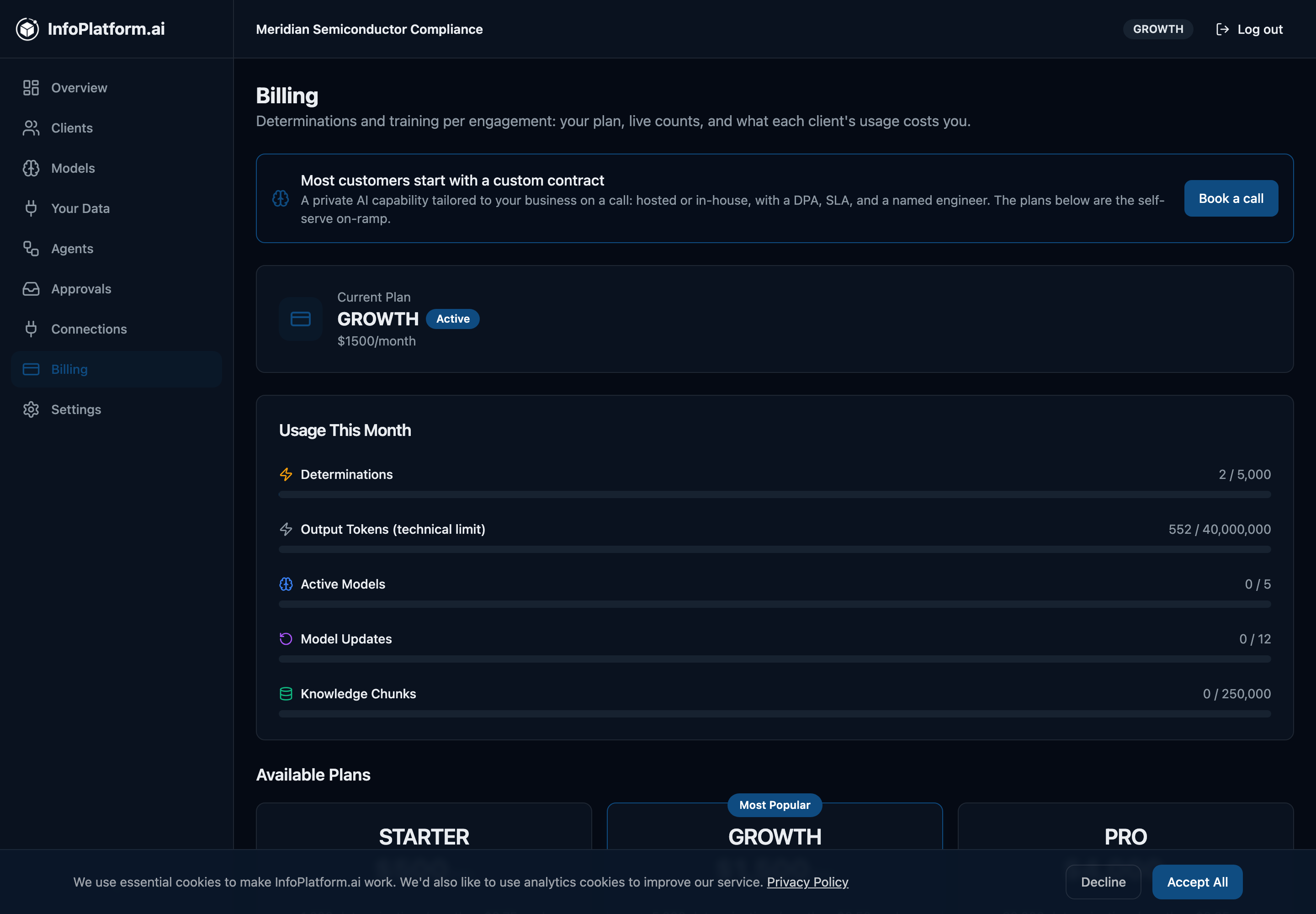
Billing
Usage you can actually see
Live counts tracked against your plan limits. No surprise invoices.
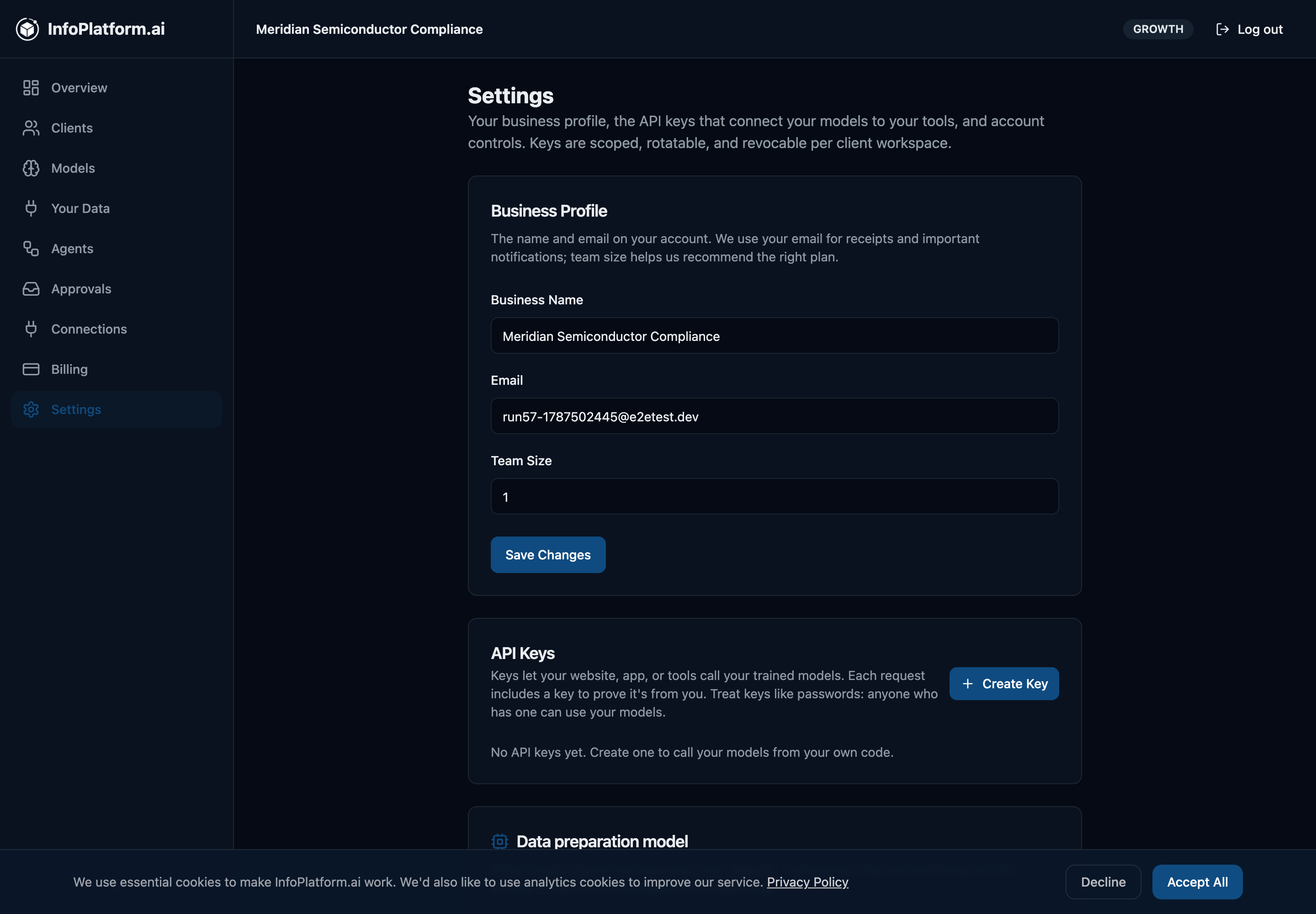
Settings
Your account, your keys
Create, rotate, and revoke the API keys that call your models.
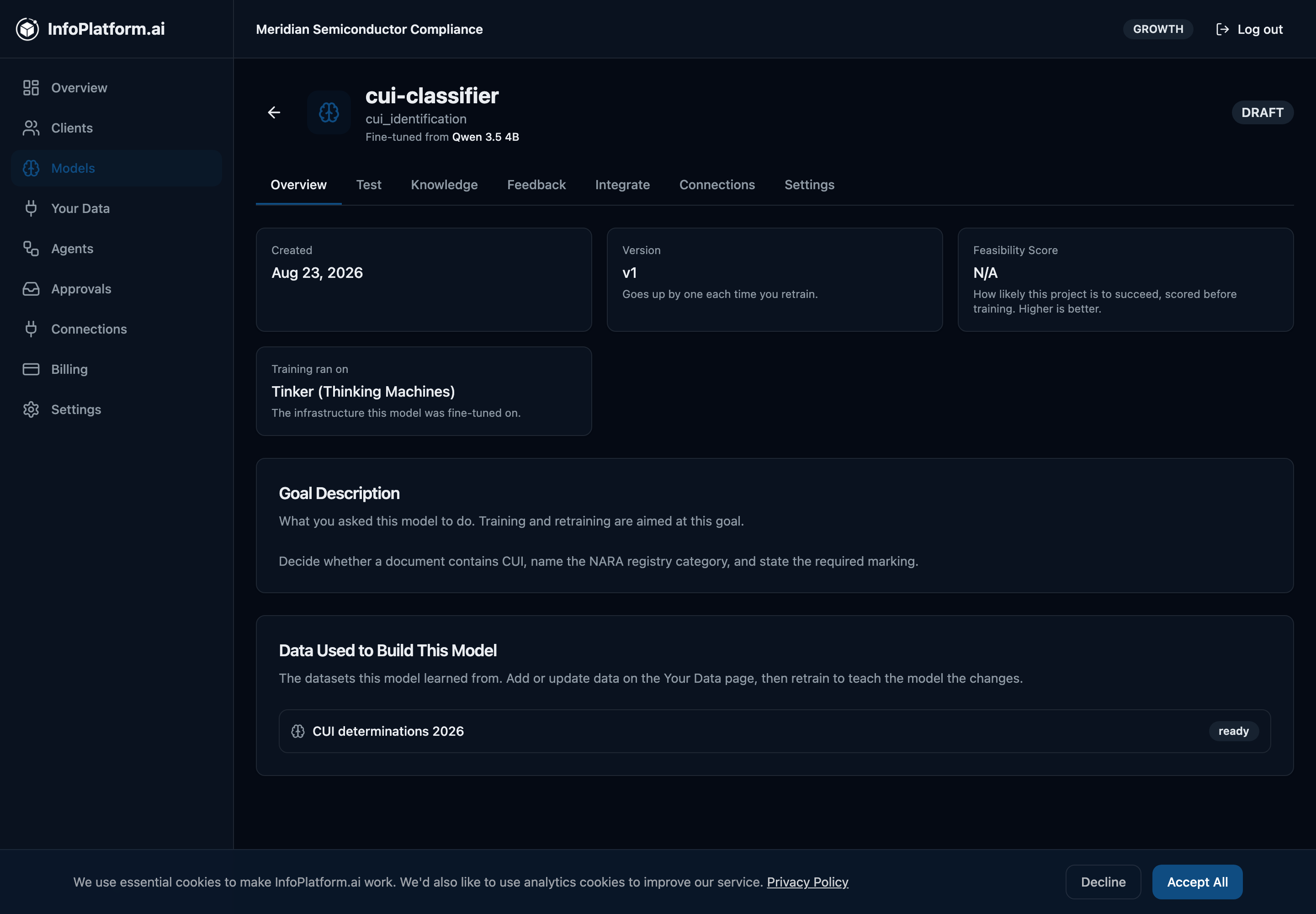
Before You Train
AI-Powered Feasibility Analysis
Before you spend a dollar on GPU time, our feasibility engine scores your data quality, task complexity, and expected performance, with a radar chart and a cost estimate.
- Radar chart scoring across 6 dimensions
- Accurate cost and time estimates before training
- Actionable recommendations to improve data quality
- Go / No-go recommendation with confidence score
Fully Automated
Event-Driven Training Pipeline
When you hit "Train," we spin up a GPU instance, fine-tune your model, encrypt and store the weights, then spin down the infrastructure. Zero idle compute costs.
- Spin up on demand, no standing infrastructure
- Pay per training run, not per hour
- Optionally delete your uploaded data the moment training finishes
Ship & Improve
Test, Deploy, and Improve
Your trained model serves from a private, OpenAI-compatible endpoint. Test it in the built-in chat, hand your team the one-line swap, connect its tools via MCP, improve it with your feedback.
- One-line base_url swap into the OpenAI SDK, LangChain, OpenCode, or Cursor
- Give the model your tools with model-level MCP
- Built-in feedback + one-click retrain that learns from your corrections
Everything You Need to Train Custom AI
A complete platform from data ingestion to production inference.
Best-in-Class Open Models
Kimi K2.6, DeepSeek V3.1, Qwen 3.5, Nemotron 3, GPT-OSS, or Inkling, trained as the exact weights you pick.
You Own the Weights
Export your adapter and run it anywhere, or let us serve it. No shared-model lock-in.
Hosted or In-House
Start self-serve on our dedicated GPUs (or Tinker), or contract an in-house deployment with DPA, SLA, and a named engineer.
One-Line OpenAI SDK Swap
Change base_url and ship. Works with LangChain, LlamaIndex, OpenCode, Cursor, or any HTTP client.
Just Upload Your Data
Spreadsheets, documents, code, exports, cleaned, deduped, and prepared automatically.
Viability Check First
We analyze data quality and task complexity before you pay a dollar, so you know it'll work.
Learns From Your Corrections
Fix wrong answers; a one-click retrain improves the model exactly where it missed.
Agents With a Human Sign-Off
Put an approval gate anywhere in a workflow. Nothing ships until a person decides.
Model-Level MCP
Connect knowledge bases, ticketing, or internal APIs per model. Encrypted credentials, zero infra.
Transparent Costs
Clear dashboards for training runs, token usage, and inference volume. No surprises.
Delete Your Data After Training
Raw files are permanently erased the moment training finishes. Your model keeps working.
Pricing built for ownership
You're billed per determination: one completed answer, however many model calls it took to produce. Shape a contract on a call, or start self-serve below. No free tier, no trial.
Enterprise
Tailored to your business
Determination volumes set by contract
- A contract tailored to your needs and requirements
- Hosted with us, or implemented in-house on your own infrastructure
- Every open model, dedicated capacity, custom volumes
- DPA, SLA, data-residency and security review support
- Named engineer and priority everything
- You own the data, the weights, the training, the inference
Starter
Base platform fee, training included
1,000 determinations included, then $0.75 each
- 2 custom models, fine-tuned on your own data
- 1 configurable agent with human-approval steps
- 3 training runs per month
- Knowledge Base: 50k indexed chunks with cited answers
- Fine-tune the exact model, own the weights
- Email support
Growth
Base platform fee, training included
5,000 determinations included, then $0.50 each
- 5 custom models, fine-tuned on your own data
- 3 configurable agents with human-approval steps
- 12 training runs per month
- Knowledge Base: 250k indexed chunks with cited answers
- Priority support
- Usage dashboards
- Retrain from your feedback
Pro
Base platform fee, training included
20,000 determinations included, then $0.35 each
- 20 custom models, fine-tuned on your own data
- 10 configurable agents with human-approval steps
- 30 training runs per month
- Knowledge Base: 1M indexed chunks with cited answers
- The largest models (100B–1T) unlocked
- Dedicated support
- Fastest processing
Calculate Your ROI
See how much time and money your team could save with a custom AI model.
Estimated monthly savings
$1,400
Assumes 70% of these hours are absorbed by the model, an estimate, not a measured result. Compliance work scores lowest because every answer still needs a human sign-off.